
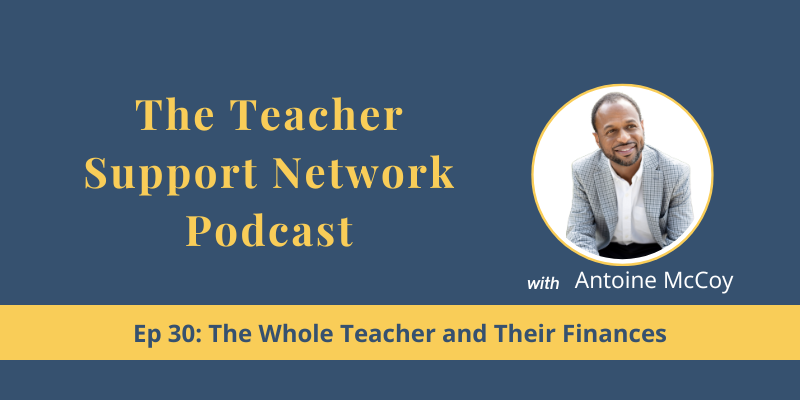
In this episode ~
Talking about finances for teachers isn’t always easy — but it’s essential.
In this reflective yet practical episode, we share how educators can take small, grace-filled steps toward better financial wellness.
From budgeting with purpose to building peace (not pressure), this is a judgment-free convo about money, values, and creating margin for what matters.
Listen in~
00:40 Understanding Financial Realities
01:35 Budgeting with Purpose
04:02 Building Financial Peace
06:46 Reflection and Action Steps
08:13 Conclusion and Resources
Useful Resources:
Free Download: Gen Ed & SpEd Teachers Collaborative Conversations Guide https://antoinemccoy.com/building-bridges/
Book that Inspired the Whole Teacher Life Series:
What Really Works: Blending the 7 F’s for the Life You Imagine by Paul Batz and Tim Schmidt
(Disclaimer: This is an affiliate link. If you choose to make a purchase after clicking the link, I may receive a commission at no additional cost to you. Thank you for your support!)
Join my Teacher Support Network Newsletter: For a weekly dose of practical strategies, tips, resources and inspiration to support you on your teaching journey.
Subscribe & Listen


Let's Get Social
Transcript
Hey, teacher friends. Welcome back to the Teacher Support Network podcast. I'm Antoine McCoy, your host, and today we're continuing with the Whole Life Teacher series and we're digging into a topic that we don't always talk about nearly enough in education. And that's finances and money matters, not just for paying bills, but for your peace of mind too.
And let's be real…between a salary you make depending on your state and school district, student loans, and side hustles, teacher finances can feel like a constant juggling act. But I’m not here to shame you. We're here to take small, honest steps towards financial wellness and we wanna do that with some grace and not guilt at all.
So let's talk first about money. I know talking about finances can be personal…even emotional. There's no one size fits all approach and I want to honor that. We all come from different places financially and the pressures we carry around money are real. Teaching is a calling, but it's also a career.
And the financial realities many educators face are really real. Maybe you're living paycheck to paycheck, maybe you have multiple streams of income that you are having to balance. Maybe you're just wondering how to save anything when prices keep rising. I've been there and I'm still on that journey for financial peace.
I've had to learn how to budget smarter, say no to some things so I can say yes to what matters, and build a mindset that really helps me to manage money and not fear it. This isn't about being perfect with finances. It's about creating a plan, one small step at a time so you feel less stressed and more free.
So let's talk a little about budgeting, and particularly budgeting with purpose. I want you to think of budgeting not as restriction, but as permission to prioritize what truly matters, whether it's groceries , giving, family fun, or saving for a goal- Having a plan really helps you stay focused and free over the years.
Here are a few things that have helped me manage my money and I'm still, like I said, a work in progress in terms of what I do with my money. One thing is having a small amount automatically deposited into my savings account each month from my paycheck so I know I'm saving consistently month to month.
Something else that's really helped is keeping an emergency or rainy day fund for things like unexpected car repairs, it always seems to go toward the car, if you know what I mean. I may need new tires or brakes or something just isn’t working and I need to take it into the shop. You know the deal.
Something else I've done too that has helped me is put money in the budget for entertainment with my family, like eating out, fun outings, and just making memories because that's something that we value.
And I also set aside my own personal blow it money. I call it "blow it” money so I can just grab a favorite coffee or lunch or just treat myself without feeling any guilt about it. So I budget those things in, not a lot of money, but enough so that I don't feel guilty having some joy in my life month to month.
And one thing I also do, and I've done this for a while, is I love to give to my church and support causes that matter to me throughout the year. Giving just really helps understand gratitude and feel grateful for the things I have, and also helps me to pour into other people.
Now, listen, this isn't the only way to manage money. There are tons of ways to manage money, and I'm sure you have your own ways of managing money, but it's just a few things that work for me, and I'm a little old school with how I handle things, so keep that in mind. The key is really finding a rhythm that matches your life and more importantly, your values.
I try to stay within the budget as best I can, but I'm also flexible as well. I reevaluate things a few times a year based on what we need as a family. Budgeting for me, like I said, is a work in progress and it's not a perfect system. It's just something that adjusts with the season I'm in, and I think it's something that's important that you adjust it with the season you're in as well.
So let's talk a little bit now about financial peace over pressure. So many teachers carry financial anxiety but we never really talk about it and we don't have to carry that weight silently. Start building peace by maybe trying a few of these things… Maybe automatically save each month even as little as $10 a month, because over time that adds up.
Something else you can do is find areas in your life that you can eliminate or adjust altogether. Perhaps you have a monthly subscription that you're paying for that you're not really using or you don't really need right now.
Another thing is saying no to unnecessary classroom spending from your own pocket. I know as teachers and educators, a lot of times we take money from our own pockets and put it into our classroom, but consider looking for local teacher grants. Maybe ask for donations from parents or booster clubs on supplies that constantly need restocking in your classroom. Even create an Amazon wishlist or something similar for other important, more pricier items.
That way you don't have to always go into your own budget to supplement what you need in the class, and you can just solicit it from other people who really wanna help and may really wanna help your students as well.
Finally, create margin in your budget whenever possible for what brings you joy. When I say margin, it's just like I said a little bit, budgeting things in your budget so that you can enjoy something small. Maybe it's a nice coffee or saving up a little bit at a time for that summer mini vacation or a trip that you wanna go on with your family.
What matters most is just alignment and spending your money in ways that reflect your values and not just your obligations. You're not alone in figuring this out. The first step might be talking to a spouse or maybe you have a friend or an accountability partner, or maybe even a financial advisor of some sort.
It’s really talking about finances with other people who can help you or you have to partner with. Something else you can try to do is really just simply write down where your money is going each month and start with this current one. You'd be surprised sometime when you write down your expenditures and what you have and where your money's going, that's where you'll be able to really see where you can maybe adjust, remove, or even have room to add something.
Knowing what it looks like on paper is really important. Small shifts create big change over time, and you're not trying to be a financial planner. You're just trying to live within your means and with a little more peace.
So here are some reflection questions that I want you to think about this week.
First one is, what's one spending area that tends to drain your budget more than it should? You might find that as you write down what you're spending your money on each week, each month. And the other reflection question is, what's one small financial decision you can make this week that moves you closer to peace?
I always like to leave you with an action step. And so the action step for this week is to pick one money area…maybe it could be subscriptions, it could be eating out, it could be looking at your classroom spending, and so forth. Whatever that might be, you get to choose and decide what you can pause, reduce, or just replace this week and then take action on it as it relates to money and spending. Like I said, baby steps, inch by inch is a cinch. Yard by yard makes it hard. Just think about the next small thing you can do to get more financial peace in your life. Be encouraged. Your worth isn't tied to your bank account, but your peace of mind is connected to your plan.
So remember, this is a journey. You're not behind and you're not alone. I think all educators and teachers, even though we don't always talk about it, our finances and managing money is an area that we continue and need to evaluate and to improve upon. So that's what this episode's really about.
So before we go be sure to check out the show notes for helpful resources, the full episode transcript, and links to connect to me with me on my social media.
That's it for now, for this week of the podcast. I hope you have an amazing week. Until next time, bye for now.
Rate, Review, & Subscribe on Apple Podcasts
Enjoy this episode?
Please consider rating and reviewing the podcast! Your support helps me support more teachers - just like you - create inclusive classrooms, foster effective teacher collaboration, and find balance with the demands of teaching in and outside of the classroom
It's easy! Click here, scroll to the bottom, tap to rate with five stars, and select "Write a Review." I'd love to know what was the most helpful or encouraging about the episode!
While you're there, you can subscribe to the podcast if you haven't already. If you're not subscribed, you may very well miss out on future episodes. 🙂 Subscribe now!